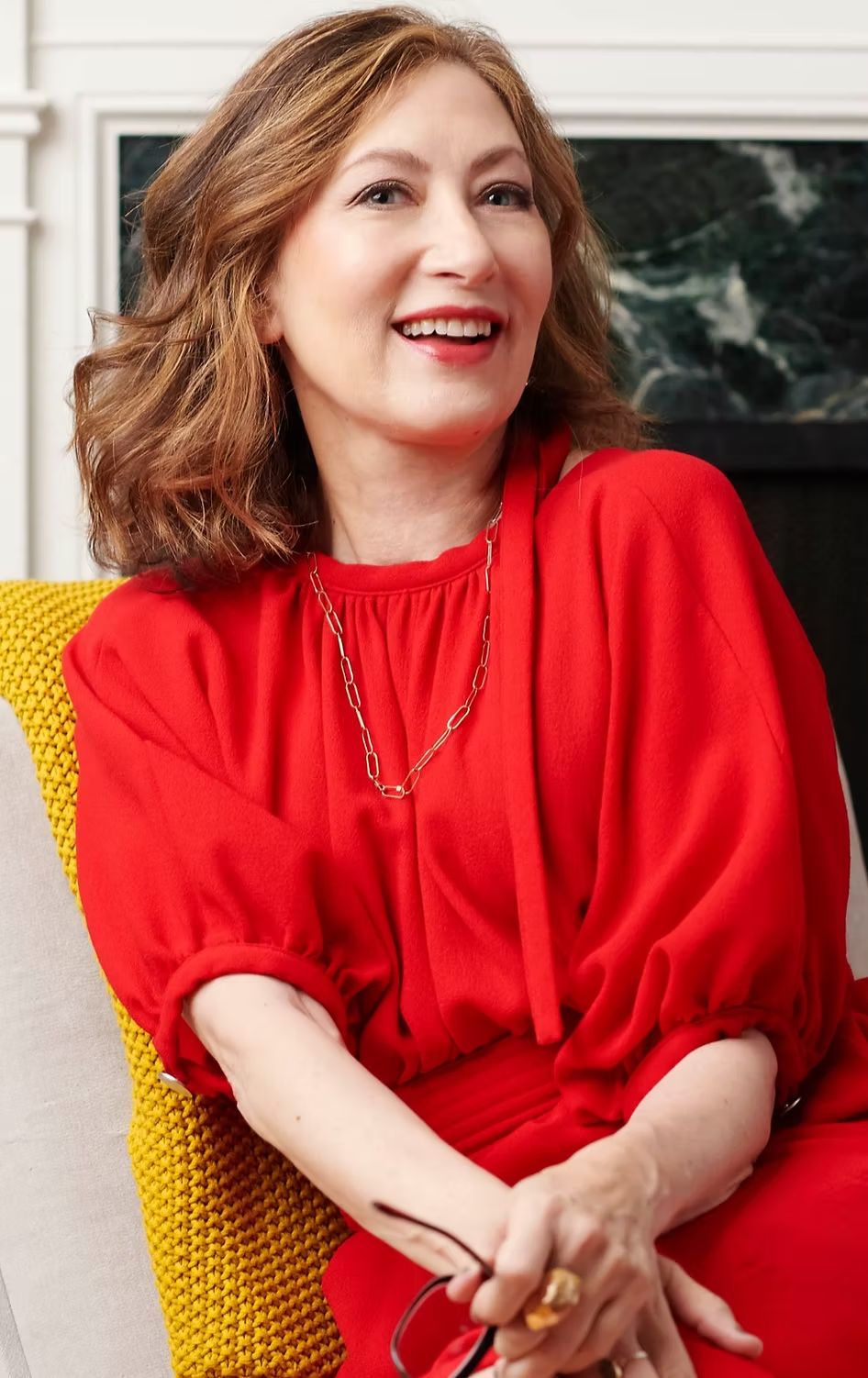
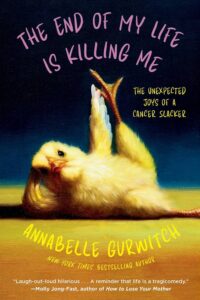
 Annabelle Gurwitch, actress, humorist, essayist, storyteller, and New York Times bestselling author of six books, has released a new book, The End of My Life Is Killing Me (Zibby Books, 2026). Released in March, the book is already a national bestseller. The inciting incident of this book is Gurwitch’s diagnosis of stage 4 lung cancer five years ago.
“I went in for a COVID test. I came out with lung cancer,” says Gurwitch. Yet Gurwitch says this book is not a “cancer memoir.” Thanks to precision medicine, her health has been stabilized by taking one pill a day, and Gurwitch has not had to go through typical cancer treatment. Nonetheless, receiving the diagnosis changed her life.
“I had these assumptions about my health, about my future, that were really wiped away in that moment and in its place came a question,” Gurwitch shares. “The question was, how do you live with existential dread? How do you live and make peace with the unknown? Which is, of course, the human experience, but for me, it was just a little bit amped up.”
The End of My Life Is Killing Me is a humorous collection of stories about the many new ways that Gurwitch chooses curiosity, openness, and joy every day. It is not a how-to-book, but it is about how Gurwitch’s changed the framework of how she experiences her life.
“The stories in the book are about all the things that I have experienced in these last five years,” she says. “As I decided, I would go beyond my comfort zone. I would push the boundaries of the known self, you might say. And so there are stories about big events like, this is how you wind up saying yes to traveling with a heavy metal band around Europe on a low-rent tour selling their merch. That’s one of the stories in the book.”
“My aim as a writer was to examine how this emotional event affected my life. And then, by sharing these stories, you know, I hope it gives the reader a chance to question how they’re experiencing their lives as well, and the ways that we think.versus the ways that we actually can change,” Gurwitch says thoughtfully. “I always think of myself as being very change-averse, so this is a book about metabolizing change.”
One of Gurwitch’s talents is that she finds humor in every situation, yet it is quickly apparent that Gurwitch is also a deep thinker.
“I have always seen, and I continue to see the absurdity in life, and that is what I’m always interested in – that space between comedy and tragedy that I think is the human experience. I don’t really think that I go to humor in a kind of joke way. But you know that there’s only one thing that occurs to me as I go through life, and that that is absurdity.
“For instance, when I hit my cancerversary of my first year after the diagnosis, I had my birthday cake. I had written on it: Not dead, just resting. I just thought, okay, this is the experience I’m going through. And I just find humor is always.the thing that I go to, and humor is such a salve. Humor provides the relief that makes it possible to survive life.”
One of the new terms that Gurwitch coins is “cancer slacker,” rather than “cancer warrior.” When asked what she means, she explains:
“I feel that very often when people are going through a trauma, whether it’s a profound diagnosis like cancer or a life experience like getting divorced. These kinds of experiences become not only the lens you see the world through, but the world puts a lot.of labels on us as someone who is in grief, someone who is in mourning, someone who is going through something, and that has implications of what that should mean. So very often when people are diagnosed with cancer, people start saying things like, well, you’re brave. You’re a warrior. You’ll get through this, and for some of us, and me included. This can seem like almost a punishment. Or it can seem like we’re letting people down if we don’t live up to that expectation.And no one can live up to that expectation all the time. And so, I wanted to give myself, and by extension, everyone else the permission to not be brave every minute of the day, to just be a human, in fact, to be an underachiever.”
Gurwitch credits other thinkers and writers with helping her develop her current framework for experiencing life.
“There are so many books that cover similar topics of survival. When I was writing this book, I leaned very heavily on a few books. One is Katherine Schultz’s Lost and Found. One was Sarah Ruhl’s book, Smile. And Jenny Odell’s book, How to Do Nothing. Those books and my book are all about the way we pay attention to living. Just by shifting slightly our attention, we experience life differently. Now mine happens to be a comedy, and I don’t know that anyone would say Jenny Odell writes comedy, but I think that is the beauty of a book, that every book is like your friend. I think my book exists in conversation with these other books. And like a group of friends, all of them have a slightly different personality.”
When asked if this outlook comes naturally for her, she replies quickly, “Oh, it takes practice, or rather intention. It’s not my first thought in the morning. It takes about three lattes, and turning my attention to say, What can I be curious about today? Can I be open to something that’s said, or something that happens? Because when I wake up in the morning, my first thought is let’s go back to bed. So, I’m not naturally that person, but this experience has changed me, and as the certainty about my sense of my future and the state of my health sort of disappeared, what took its place was either going to be just misery behind Door Number 1 or curiosity behind Door Number 2, and I picked Door Number 2, and I try to pick it every day.”
Gurwitch is also quick not to take credit for this notion of choosing intentionally. Instead, she cites the philosopher Georges Parekh, who was mentioned in Jenny Odell’s book, Saving Time:
“Parekh had written that we are all walking through our lives as if in a dream. We are sleepwalking. And if we aren’t paying attention, we are only attuned to the extraordinary, to the very large events and the big happenings in the world and in our lives; but to really wake up and experience life, we should look for the infraordinary–that layer of beauty just beneath the surface of the ordinary. When I read that at this time in my life, that became a call to action… I decided I wanted to be engaged in the world, and so to pay attention to wake up, as it were, to these very small aspects of life, because sometimes we are in compromised situations where less is available to us, but can we find meaning in that? Can we find beauty in that? Or are we moving so quickly? Are we part of the distraction of the world? This has been a real change for me, and in all that, I always try to find the humor.”
Asked whether this book is specifically for someone going through trauma, Gurwitch replies, “This book is for everyone. We all need little respites and small rescues against existential despair.”
The End of My Life Is Killing Me can be found anywhere books are sold. For information about Gurwitch’s book tour schedule, please visit annabellegurwitch.com
____
Wendy Wong is a certified Jungian coach who leverages the energy arts – Reiki, qigong, tai chi, shadow work, and dream analysis – for insight, creativity, healing, and growth. She writes fiction and narrative non-fiction, and is a staff writer for the San Diego Writers Festival and International Memoir Writers Association. She is also the San Diego Regional Ambassador for The Authors Guild.